
Cyber Security Risk Managemnt
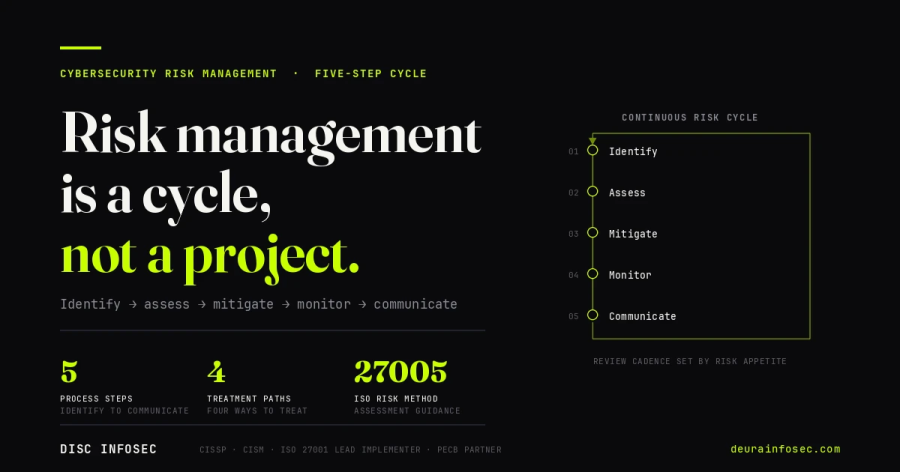
Risk management is a cycle, not a project
Most organizations run risk management as a project: assess once, produce a register, circulate the report, move on. The register starts aging the day it's signed. New systems ship, vendors get onboarded, staff change roles, and controls quietly decay through configuration drift and turnover. Within two quarters the document describes an organization that no longer exists, and the risks that actually matter are ones nobody has looked at yet.
ISO 27001 anticipates this. Clause 8.2 requires risk assessments at planned intervals and whenever significant changes are proposed or occur. Clause 9.3 puts risk in front of management on a recurring agenda. Clause 10.2 closes the loop on what failed. Read together, they describe a cycle, not a deliverable. In practice that means a living register with named owners, dated reviews, and visible score changes — and a review cadence driven by your risk appetite rather than your audit calendar.
Cybersecurity risk management involves a series of steps to identify, assess, and mitigate risks to an organization's information systems. Here are the key steps:
-
Risk Identification: Identify potential risks, including vulnerabilities, threats, and potential impacts on systems and data.
-
Risk Assessment: Evaluate the likelihood and potential impact of each risk, prioritizing them based on their severity.
-
Risk Mitigation: Implement measures to reduce or eliminate the identified risks. This may include deploying security controls, updating software, or enhancing monitoring.
-
Monitoring and Review: Continuously monitor the system for new risks and assess the effectiveness of existing controls. Update the risk management plan as needed.
-
Communication and Documentation: Ensure that risk management processes and findings are documented and communicated to stakeholders, keeping everyone informed about the current risk posture.
 Print
Print